
The Bar faces an AI culture clash
AI adoption has now outpaced the slow-moving corporate culture of UK law



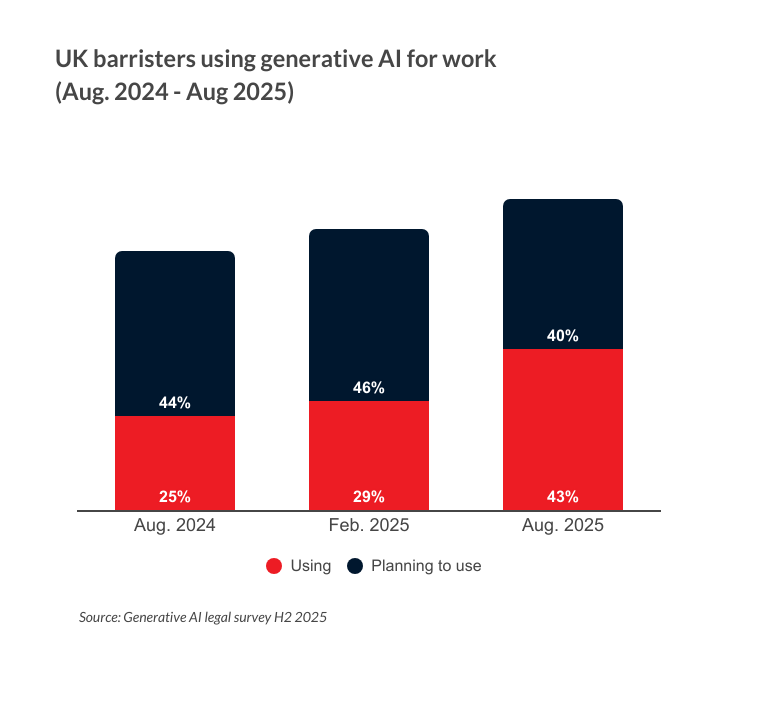
More than four in five barristers are already using, or planning to use, AI tools.
But have barristers successfully embedded AI into their workflow and operations? Apparently not.
Our latest generative AI survey found barristers are still struggling to balance speed with accuracy, increase outputs without extra workload, and deliver greater value without undermining legal expertise.


AI is now commonplace among barristers
The latest LexisNexis survey of UK lawyers, which took place in August 2025 and included 700+ legal professionals, found:
Almost half (43%) of barristers use generative AI for work purposes
This is an increase from the 29% we saw in our January 2025 survey.
In addition, 40% expressed plans to adopt AI in the near future, while 18% revealed no plans to use AI.
One respondent from the Bar said:
"AI is much faster. I can get to the source materials and go through the sources and check if I agree with the AI summary."
While AI adoption is growing rapidly across the Bar, our research found progress is being stalled by rigid corporate cultures.




Barristers say AI culture is slow-moving
A top challenge facing barristers is keeping pace with new technology. More than a third (37%) listed this as a challenge.
While AI adoption is rising fast, barristers are being held back by slow-moving organisational cultures.
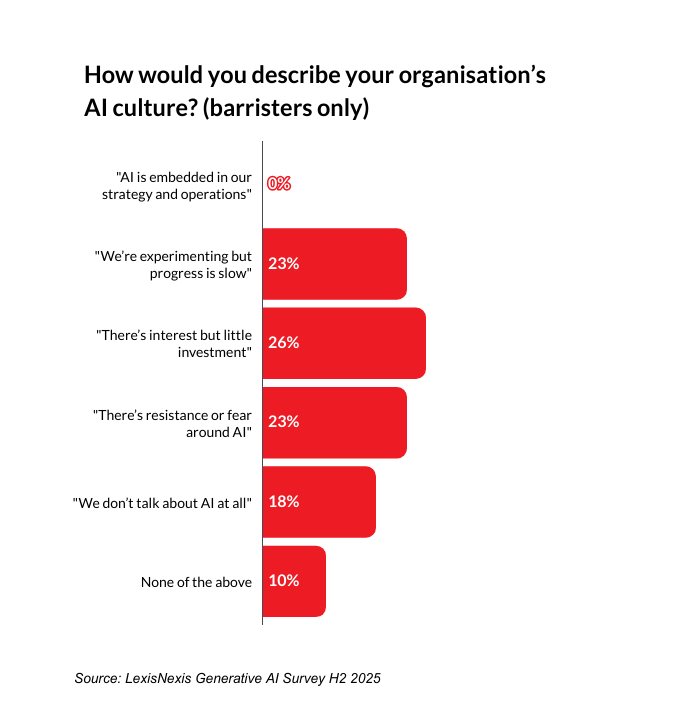
No barristers included in our survey said AI is "embedded in their strategy and operations".
The most common response was “there's interest but little investment" at 26%.
Meanwhile, 23% said "we’re experimenting but progress is slow”, 23% reported resistance or fear, and another 18% said AI isn’t discussed at all.
One barrister told us there is a general reluctance to embrace new technology in pockets of the profession.
Another said AI-powered research, analysis and the like are simply tools to be more effective as a barrister.
This is far more than just a technology rollout, says Gerrit Beckhaus, a partner at Freshfields and Co-Head of Freshfields Lab.
"AI demands clear strategic direction and communication from the top, tying it to client-value outcomes and measurable impact."
Michelle Holford, Chief Commercial Officer from Slaughter and May, says:
"If you’re using AI correctly, it should be delivering a better outcome or making someone’s life easier."
Yet adoption is hard, she notes. "You have to give lawyers time to play, learn and fail in order to work out how best to use a new tool. It’s not always easy to create the space for those things to happen in a fast-moving, high-pressure environment but doing so reaps rewards."
Embedding AI into strategy and operations comes down to good change management, says Eversheds Sutherland's Director of Legal Technology, Bhavisa Patel.
"You can have the best solution, but if people don’t know what it is, how to use it, or how it will help them, the benefits will always be limited."
Another factor stalling innovation is that many of these tools are still evolving and ROI remains elusive, says Sarah Barnard, the Director of AI Delivery at Linklaters.
"Some firms are waiting for clearer evidence of value before making major AI investments."
This mix of enthusiasm, caution, and cultural resistance shows that while AI adoption is advancing, the profession is still far from unlocking its full potential.


What AI tools are barristers using?
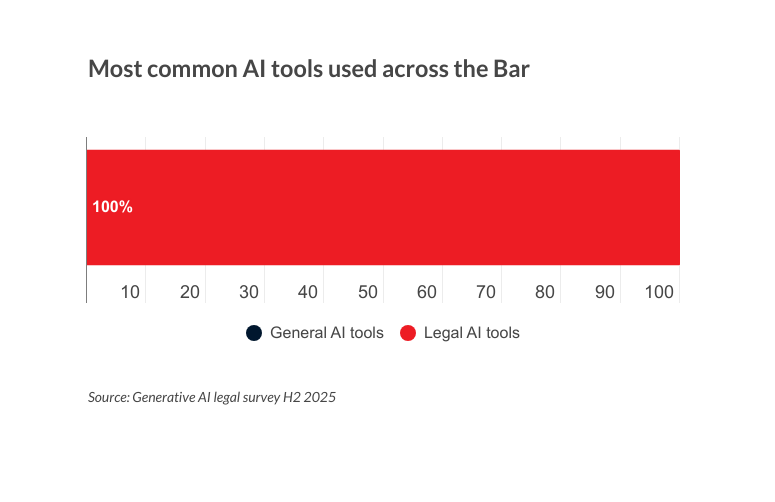
Our survey revealed all (100%) of barristers using AI have a preference for tools built specifically for legal work, such as Lexis+ AI.
Almost half of barristers using AI have invested in purpose-built legal tools
Trust in both law and AI relies on credibility and transparency, says Candice Donnelly, recently the Director of Legal, Corporate at Skyscanner.
"As practitioners, we rely on sources that we know from experience to be reputable. With AI tools still at a relatively early stage of development, that trust still needs to be earned, not assumed, and AI needs to respect the fact that the source still matters as much as the substance."
One of AI’s biggest time-saving benefits for barristers is in legal research. According to 85% of barristers, the matters demanding the most research are in unfamiliar or highly specialised areas of law, which can be rapidly accelerated when using legal AI tools like Lexis+ AI.
One barrister told us:
"I use AI as a tool to answer preliminary questions on obscure areas of law. Once pointed in the right direction, I will then carry out my own research from my usual sources."
While AI adoption is rapidly growing, 81% of all barristers included in the survey harbour concerns over relying on inaccurate information.
Specialist AI solutions are built with lawyers in mind and trained on legal content, says Patel from Eversheds.
"Generic AI tools still remain useful for things like improving personal productivity. They just don’t have the same depth of legal context and therefore won’t be as valuable or accurate in delivering good outputs to specific and complex legal use cases."
For AI to be particularly useful for lawyers, it needs a strong grounding in the specific legal context, says Gerrit Beckhaus, a partner at Freshfields and the Co-Head of Freshfields Lab.
"AI needs access to relevant context, including proprietary knowledge, expertise, and sensitive client information that cannot be shared with public chatbots."
This comes down to a good understanding of the legal services sector, says Barnard from Linklaters.
"Legal AI tools are intended for use by lawyers, and vendors are aware of how stringent their approach to compliance and data security must be. This is an area where general tools often fall short."
For the risk-averse legal profession, confidence in AI use is closely tied to the quality of its sources.
Overall, 67% of barristers said they would or do feel more confident using AI when it's grounded in trusted legal sources.
Get instant answers grounded in the UK’s most trusted legal sources
When an AI tool can demonstrate that its output is grounded in quality resources, it shifts from being a clever search assistant to a credible aide, Donnelly notes.
The forces shaping AI adoption are shifting fast and differ across organisations. So what’s the reality for lawyers using these tools day to day?



How barristers will spend the time saved using AI
With AI speeding up legal research, drafting and administrative tasks, barristers are using the free time saved to increase chargeable work and enjoy a better work-life balance.
Almost half (46%) of barristers repurpose the time saved using AI to focus on increasing chargeable work
Meet deadlines, manage risk, and deliver stronger outcomes under pressure.
Those using AI are far more likely to use the time saved to attempt to increase chargeable work (46%). However, just as many (46%) are using AI to enjoy a better work-life balance.
Does this mean the billable hour is already being phased out to increase chargeable work? Or perhaps non-billable work is taking less time, clearing more space for high value, billable work?
Lawyers spend a lot of time on administrative tasks, says Patel from Eversheds.
"Without the administrative burden, lawyers can focus on how to turn a good client relationship into a deep strategic partnership, which in turn will lead to higher quality outputs and happier clients."
Lawyers should also be able to manage a better work-life balance in general, says Patel.
Donnelly says producing reports and standard documentation can take up a lot of time for lawyers.
"Over the past 12 months, we have seen a real increase in AI tools that can handle these tasks with speed and consistency."
This has enabled teams to focus on more strategic advisory work and complex problem-solving, says Donnelly.
AI has the potential to rebalance how we use our time by helping us work a little smarter, she notes.
"It’s not about saving time. It’s helping us redefine how we spend it best individually and as a team."
One General Counsel said AI allows their department to get a rough idea of the answer before testing it with other sources.
"We don't 100% rely on AI but it helps make the interaction with external counsel quicker and cheaper."
Another General Counsel told us: "We have a service-driven culture, and using tech to lead would be a considerable change."
As a greater proportion of legal work becomes automated or streamlined, there will eventually be a shift from hours worked to value delivered. Pricing will, as many expected, become a topic of discussion.





Matching pricing models to value delivered
AI's influence on the legal sector can be seen clearly in pricing models.
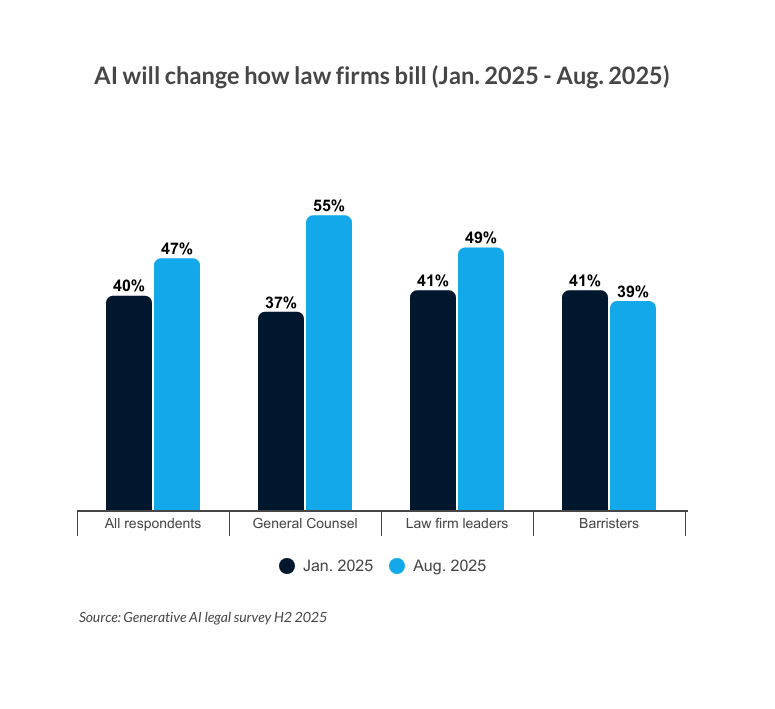
In our January 2025 survey, 40% of all respondents agreed that AI would change how firms bill. Just a few months later, that figure has jumped to 47%. This shift is particularly prevalent in general counsel (55%) and law firm leaders (49%).
A significant 39% of barristers agreed that AI will change how external counsel bill.
One barrister expressed concern that clients might start bypassing legal.
"I think the biggest challenge is that non-lawyers will use Legal AI and think it's a substitute for using real lawyers."
Calculating how to charge for work will be a challenge for many barristers, one respondent told us, especially when the billable hour no longer provides a sensible measure for work.
"Given lawyers' reliance on billing by the hour, clients will expect lower fees because AI delivers quicker results."
Another noted this impending shift in expectations.
"Clients will have an increased expectation that high value professional services should provide advice that cannot be easily gleaned from readily available search tools, including those powered by AI."
There will also be an expectation of a better quality of service, he says, which will be driven by the combination of trained lawyers and trained AI.
New pricing models will emerge along with new or improved products and service offerings, says Tony Randle, a partner at Shoosmiths.
"Firms are also beginning to offer clients self-serve products and managed service solutions that combine tech solutions with related legal support."
"We expect more fixed, portfolio, and subscription pricing, reflecting both client demand for predictability and AI’s role in reshaping service delivery to improve outcomes and value."
The evolution of law firm pricing models, therefore, seems imminent rather than speculative.


The impact of AI on the workforce
The knock-on effects of failing to adequately invest in AI are becoming clear.
Overall, only 5% said they would consider leaving if their organisation failed to invest in AI. However, this could soon change as adoption rises. Almost one-fifth (19%) of in-house corporate and 18% of private practice respondents agreed with this statement.
Only 5% of barristers would consider leaving if their organisation failed to invest in AI
In addition, 27% said that a failure to engage with AI would negatively affect their careers.
Slaughter and May's Holford says this comes down to culture.
"If you can be open minded and have a willingness to experiment, it creates a culture where people are keen to try new technologies, not having them forced upon them."
In addition, support around AI is also limited:
- Only 8% said their organisation had provided them with appropriate training to use AI safely
- Only 13% have an AI policy that is easy to understand and follow.
Donnelly says AI is no longer a future consideration but a present-day expectation.
"While a company may have seen AI as a novelty or a box-ticking exercise, now a legal function expects access to an AI tool that enables it to focus increasingly on high-value, judgment-driven work."
To attract and retain talent, Donnelly says legal teams need to streamline contract analysis, enhance regulatory tracking, and support decision-making with contextual intelligence to accelerate delivery.
Barristers using AI should be openly communicating the benefits. This will give lawyers the confidence to let AI do the heavy lifting and use these tools to their full potential.





Do your lawyers have "permission" to use AI?
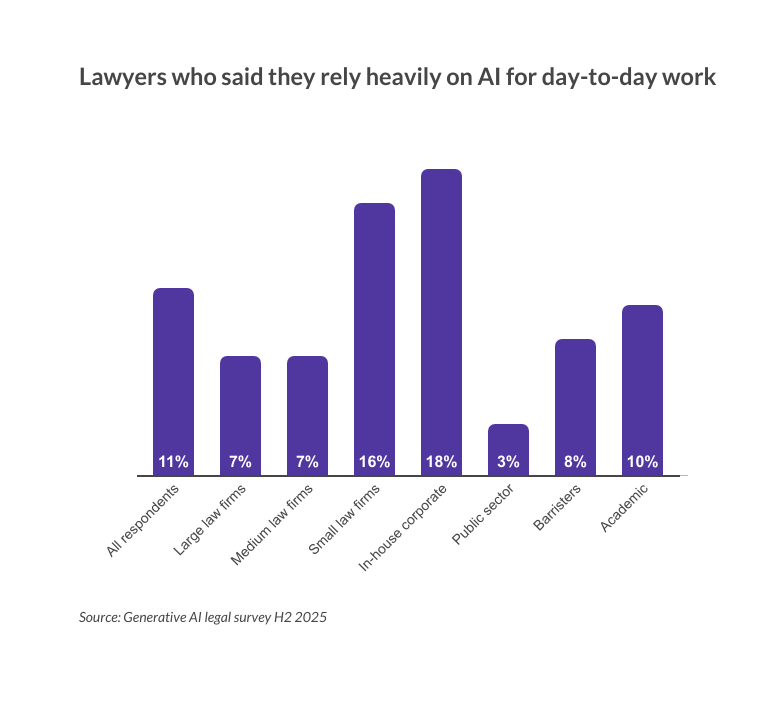
Despite adoption escalating, only 8% of barristers rely heavily on AI for their day-to-day work.
Only 8% of barristers rely heavily on AI
This finding is a double-edged sword: while “heavy use” might suggest over-reliance or complacency, it can also highlight the opposite problem: they're afraid to use it or afraid to talk about using it. Many teams remain wary of depending too much on AI. In fact, one of the biggest concerns when using AI is becoming too reliant on it (27%).
Beckhaus from Freshfields says AI should also be embedded into existing workflows and knowledge systems.
"AI tools should be supported by hands-on, role-based enablement and credible role models at every seniority level to build trust and adoption."
Barnard from Linklaters says barristers should focus on building their people's confidence when using AI, highlighting where it adds value and where it has limitations.
"By managing expectations and providing practical support, legal teams avoid the disillusionment that can often follow initial hype and instead create real, sustainable value from AI."
The organisations making the most headway are the ones with a senior leadership team that recognises AI adoption and integration are fundamental for future business success, Randle from Shoosmiths notes.
"The biggest strides come from firms where the most senior people are leading by example, using AI on a daily basis and demonstrating to everyone in the firm how it can help them with their everyday workload."
The use of AI still comes with a stigma of cutting corners. Legal leaders need to have honest and open conversations about when their teams should be using AI, embedding confidence and encouraging its use.
AI is no longer a question of if, but how fast.
AI is already reshaping the work of barristers, offering faster research, efficiency gains, and time reclaimed for both client work and balance.
But cultural hesitation, lack of training, and uncertainty around billing risk slowing progress. The Bar has a choice: treat AI as a strategic enabler, investing in trusted tools, skills, and new value-based models, or risk falling behind peers and clients. Those who lead with confidence will set the standard for the profession’s future.


 Built with Shorthand




Insights
Popular Links
Help & Support

All rights reserved. RELX Group and the RE symbol are trade marks of the RELX Intellectual Properties SA, used
under license.